Home > Insights > Product Guides > Backpack Mist Duster Guide
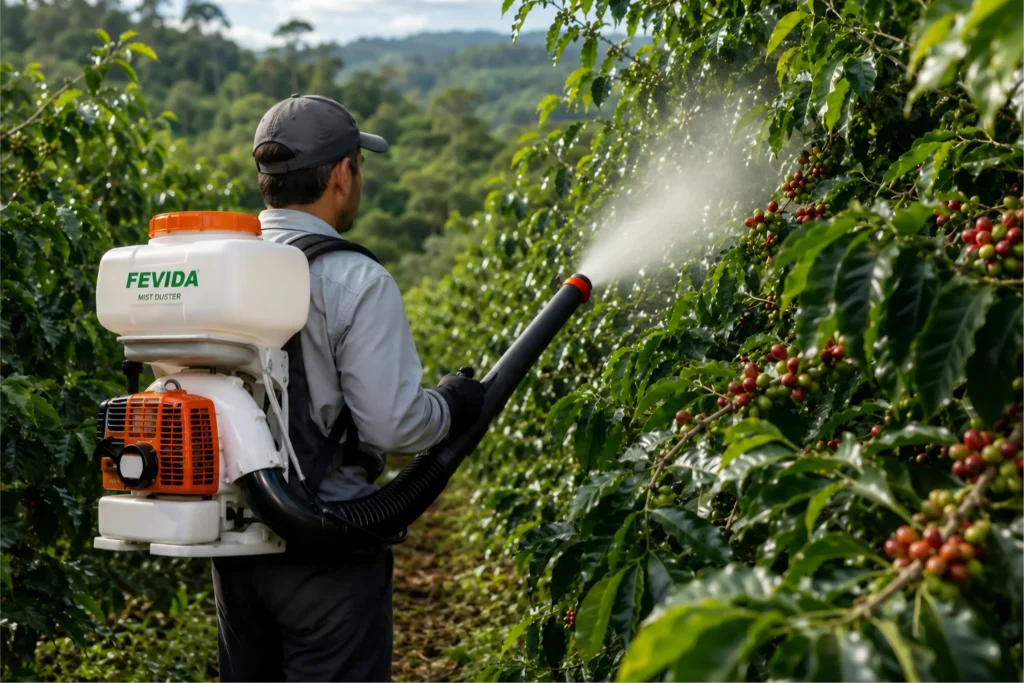
How to Choose the Right Sprayer for Coffee Farms and Orchards
Choosing a sprayer for coffee farms or orchard is not simply a matter of selecting the largest tank or the most powerful engine.
Terrain, crop height, canopy density, spraying distance, working area and labor conditions can all affect which type of sprayer performs best.
This is especially important for coffee farms and orchards, where operators may need to move between rows, work on slopes, reach dense foliage or spray areas that are difficult for large agricultural machinery to access.
Battery backpack sprayers, mist blowers and power sprayers can all be useful in these applications, but they are designed for different working conditions.
Understanding those differences can help farmers, distributors and agricultural equipment dealers select a more suitable product range.
How to Choose a Sprayer for Coffee Farms and Orchards
Coffee plantations and orchards can vary considerably from one market to another.
A relatively flat orchard with wide spacing between trees has different equipment requirements from a hillside coffee plantation where operators need to carry equipment for long periods.
Several factors should therefore be considered before selecting a sprayer.
Terrain
Portable equipment becomes more important where large machinery cannot easily enter the field.
For hillside coffee farms, nurseries and smaller orchards, backpack equipment allows operators to move between plants without depending on vehicle access.
Weight, balance and carrying comfort become particularly important in these conditions.
Crop Height and Canopy Density
Young plants and open vegetable crops may only require straightforward targeted spraying.
Mature coffee plants and fruit trees, however, can develop denser canopies.
In these applications, simply increasing liquid pressure does not always provide better coverage. Airflow, droplet distribution and the ability to reach the inner canopy can become more important.
Working Area
A small nursery and a commercial orchard have very different operating requirements.
For smaller areas, a battery backpack sprayer may provide sufficient capacity and operating time.
For longer working periods or applications requiring higher pressure and longer hoses, a power sprayer may be more appropriate.
Labor and Daily Operation
Equipment also needs to match the people who use it.
Easy starting, simple controls, manageable weight and straightforward maintenance can be as important as maximum power.
For distributors, these practical considerations often determine whether customers continue using a model and purchase replacement units or spare parts later.
Battery Backpack Sprayer: Flexible for Daily Crop Protection
Battery backpack sprayers are increasingly practical for applications where mobility, simple operation and targeted spraying are important.
They can be particularly suitable for:
- Coffee farms
- Nurseries
- Vegetable production
- Young orchards
- Greenhouses
- Garden and landscape applications
- Targeted pest and disease control
Unlike a manual knapsack sprayer, the operator does not need to continuously pump by hand.
This can reduce physical effort during repeated daily spraying and provide more consistent pressure during operation.
Battery sprayers are also relatively quiet and normally easier to start and operate than gasoline-powered equipment.
For coffee farms located on slopes or in areas where operators need to move frequently between plants, these characteristics can be useful.
However, buyers should not evaluate a battery sprayer only by tank capacity.
Battery type, battery capacity, pump performance, working pressure, nozzle options and replacement-part availability should all be considered.
A 16L or 20L tank may look similar between different models, while battery life and pump configuration can make their actual working performance very different.
Best suited for: portable daily spraying, smaller and medium-sized farms, nurseries and areas where simple operation is a priority.
Mist Blower: Better for Dense Canopies and Wider Coverage
A backpack mist blower works differently from a conventional liquid sprayer.
Instead of relying mainly on liquid pressure, the machine generates a strong airflow that carries fine droplets toward the crop.
This can be useful when treating mature coffee plants, fruit trees and other crops with relatively dense foliage.
The airflow helps distribute droplets around leaves and through parts of the canopy that can be difficult to reach with a conventional spray lance.
Typical applications include:
- Mature coffee plantations
- Fruit orchards
- Pest control
- Dense crop canopies
- Larger areas requiring greater spraying distance
When evaluating a mist blower, distributors should pay attention to more than engine displacement.
Important specifications include airflow, spraying distance, liquid output, tank capacity, machine weight and engine reliability.
For operators carrying the machine for extended periods, harness design and weight distribution should also be considered.
A more powerful machine is not automatically the best choice if it becomes difficult to carry or unnecessarily increases fuel consumption.
Best suited for: coffee plants and orchard crops with denser foliage, applications requiring stronger airflow and greater coverage.
Power Sprayer: Higher Pressure for Longer Working Periods
Power sprayers are better suited to situations where higher pressure, longer hoses or continuous operation are required.
They are often used around:
- Orchards
- Vegetable farms
- Farm facilities
- Larger nurseries
- Fixed or semi-fixed spraying areas
- Applications requiring longer spray hoses
Because the pump and engine do not need to be carried on the operator’s back in many configurations, a power sprayer can support longer spraying periods and multiple hose arrangements.
This makes it useful when mobility inside steep fields is less important than working pressure and continuous output.
For distributors, pump quality is one of the most important areas to evaluate.
Pressure stability, seals, valves, hoses, spray guns and replacement parts directly affect the long-term service requirements of the machine.
Best suited for: higher-pressure applications, larger working areas and operations where longer hoses or continuous spraying are required.
Battery Sprayer vs Mist Blower vs Power Sprayer
There is no single sprayer that is best for every coffee farm or orchard.
The right choice depends on the application.
| Application | Battery Backpack Sprayer | Mist Blower | Power Sprayer |
|---|---|---|---|
| Small coffee farms | ★★★ | ★★ | ★★ |
| Hillside terrain | ★★★ | ★★★ | ★ |
| Young orchards | ★★★ | ★★ | ★★ |
| Dense orchard canopy | ★★ | ★★★ | ★★★ |
| Easy mobility | ★★★ | ★★★ | ★ |
| Higher pressure | ★★ | ★★ | ★★★ |
| Simple daily operation | ★★★ | ★★ | ★★ |
| Longer continuous spraying | ★★ | ★★ | ★★★ |
The table should be treated as a general guide rather than a fixed rule.
Local crop conditions, operator habits and spraying methods should always be considered.
Tank Capacity Is Important — But It Is Not the Only Specification
Tank capacity is often one of the first specifications buyers compare.
Common backpack sprayer sizes include 16L and 20L, while mist blowers may use different tank capacities depending on machine design and market requirements.
A larger tank reduces the number of refills, but it also increases the weight carried by the operator.
For hillside coffee farms, this trade-off can be important.
A lighter machine with adequate operating time may sometimes be more practical than simply choosing the largest available tank.
Distributors should therefore evaluate tank capacity together with:
- Empty machine weight
- Battery or engine performance
- Working pressure
- Spray distance
- Harness design
- Nozzle options
- Spare-parts availability
Consider Maintenance and Spare Parts Before Choosing a Model
The purchase price is only one part of the cost of agricultural equipment.
Sprayers operate with water, chemicals, pressure, seals, hoses and moving components, so some parts will eventually require maintenance or replacement.
For battery backpack sprayers, commonly requested parts may include:
- Pumps
- Batteries
- Chargers
- Switches
- Hoses
- Spray lances
- Nozzles
- Seals
For mist blowers and gasoline-powered equipment, distributors may also need:
- Carburetor parts
- Recoil starter components
- Air filters
- Fuel-system parts
- Spark plugs
- Hoses and fittings
A distributor that keeps common replacement parts in stock can normally provide better after-sales support than one that only sells complete machines.
For this reason, spare-parts planning should begin when selecting the machine, not after customers start reporting maintenance requirements.
What Distributors Should Consider When Building a Sprayer Product Line
For importers and agricultural equipment dealers, one model rarely covers an entire market.
Different customers have different budgets, crops and working conditions.
A more practical product structure can include several levels.
Entry-Level Products
Manual knapsack sprayers can serve customers looking for simple equipment, lower initial cost and easy maintenance.
Mainstream Products
Battery backpack sprayers can cover a wide range of farm, nursery, orchard and garden applications.
They are often a practical middle option between manual equipment and gasoline-powered machines.
Higher-Performance Products
Mist blowers and power sprayers can serve customers who need greater spraying distance, airflow, higher pressure or longer continuous working periods.
Spare Parts and Accessories
Nozzles, hoses, pumps, batteries, spray guns and engine parts can create an important second layer of the product line.
This structure allows distributors to serve several customer groups instead of competing with only one sprayer model.
Considerations for Coffee-Growing Markets in Latin America
Coffee-growing regions across Latin America can include mountains, valleys, humid production areas and farms of very different sizes.
That makes portable spraying equipment particularly relevant in certain applications.
Colombia
Coffee production areas can include steep terrain and farms where equipment needs to be carried between plants.
In these conditions, machine weight, portability and simple daily operation deserve particular attention.
Battery backpack sprayers can be useful for targeted spraying and routine crop protection, while mist blowers may be more appropriate where stronger airflow and canopy penetration are required.
Distributors serving these markets should also pay attention to spare parts and simple maintenance because equipment may be used far from large service centers.
Brazil
Brazil has a much wider range of agricultural production systems.
Large mechanized farms may use equipment very different from backpack sprayers.
For this reason, portable FEVIDA-type equipment should not be positioned as a replacement for large tractor-mounted or self-propelled spraying systems.
More appropriate applications include coffee farms, orchards, nurseries, horticulture, farm maintenance and targeted treatment in areas where larger machinery is unnecessary or difficult to use.
Choosing the right market segment is therefore just as important as choosing the right machine.
How to Choose Between the Three Types
A simple way to decide is to start with the working condition.
Choose a battery backpack sprayer when mobility, easy operation and targeted spraying are the main priorities.
Choose a mist blower when airflow, canopy coverage and spraying distance are more important.
Choose a power sprayer when higher pressure, longer hoses and continuous operation are required.
For distributors, the strongest product range may include more than one of these solutions rather than trying to make one machine fit every application.
Frequently Asked Questions
What type of sprayer is best for coffee farms?
There is no universal answer. Battery backpack sprayers are suitable for many routine and targeted spraying applications, while mist blowers may be more appropriate for dense coffee canopies. Farm size, terrain and spraying requirements should determine the final choice.
Is a battery backpack sprayer suitable for orchards?
Yes. Battery backpack sprayers can be suitable for young orchards, targeted spraying and routine maintenance. For large or dense tree canopies, a mist blower or higher-pressure system may provide better coverage.
When should I choose a mist blower instead of a battery sprayer?
A mist blower becomes more useful when airflow and canopy penetration are important, particularly for mature trees and dense foliage.
Is a larger tank always better?
No. Larger tanks reduce refill frequency but increase carrying weight. Terrain, operator comfort and working time should be considered together with tank capacity.
What spare parts should sprayer distributors keep in stock?
Common items include pumps, batteries, chargers, hoses, spray lances, nozzles, seals and switches for battery sprayers, as well as engine and fuel-system components for gasoline-powered equipment.
Building the Right Sprayer Range for Your Market
The best sprayer is not necessarily the machine with the largest tank, highest pressure or biggest engine.
It is the machine that matches the crop, terrain, operator and working method.
For agricultural equipment distributors, understanding these applications makes it easier to build a product line with clear differences between entry-level, mainstream and higher-performance models.
FEVIDA supplies battery backpack sprayers, backpack mist dusters and mist blowers, power sprayers and related spare parts for distributors and agricultural equipment businesses.
Model selection can be based on local crops, working conditions, target price levels, packaging requirements and after-sales support needs.
Explore our Battery Backpack Sprayers
Explore our Backpack Mist Dusters & Mist Blowers
Explore our Power Sprayers
Contact FEVIDA for product selection and distributor support.
Choosing a sprayer for coffee farms or orchard is not simply a matter of selecting the largest tank or the most powerful engine.
Terrain, crop height, canopy density, spraying distance, working area and labor conditions can all affect which type of sprayer performs best.
This is especially important for coffee farms and orchards, where operators may need to move between rows, work on slopes, reach dense foliage or spray areas that are difficult for large agricultural machinery to access.
Battery backpack sprayers, mist blowers and power sprayers can all be useful in these applications, but they are designed for different working conditions.
FEVIDA Support for Overseas Distributors
FEVIDA supplies backpack mist dusters, mist blowers and related agricultural spraying equipment for overseas distributors, importers and equipment businesses.
We help customers compare product options, check key specifications and arrange suitable supply solutions based on target market needs.
If you are selecting backpack mist dusters for orchard spraying or farm pest control, contact FEVIDA to discuss product models, spare parts and supply options.
Need Help Choosing Backpack Mist Dusters?
Tell us your target market, application needs and preferred specifications. FEVIDA can help you compare suitable backpack mist dusters, mist blowers and spare parts for your business.
Frequently Asked Questions
What is the difference between a backpack mist duster and a manual sprayer?
A backpack mist duster uses engine-powered airflow to support wider spraying coverage and longer spraying distance. Manual sprayers are simpler and more suitable for small gardens, light farm work and lower-volume spraying needs.
Are backpack mist dusters suitable for orchard spraying?
Yes. Backpack mist dusters are commonly used for orchard spraying, fruit tree pest control and crop protection because they can provide stronger airflow and better coverage for trees and dense plant canopies.
What tank capacity is suitable for orchard and farm use?
Many backpack mist dusters use tanks around 14L to 20L. The best capacity depends on working area, user carrying comfort, local market preference and application frequency.
Can FEVIDA provide spare parts for backpack mist dusters?
Yes. FEVIDA can support spare parts for backpack mist dusters, mist blowers and related agricultural sprayer products, helping distributors reduce after-sales pressure and support long-term customer service.